The Universal Law of Gravitation

The Universal Law of Gravitation

Content Standards

In this lesson, the students will be able to:

  • Understand Newton’s reasoning behind the universal law of gravitation using the example of the moon’s centripetal acceleration.
  • State the universal law of gravitation and explain its mathematical form.
  • Interpret the inverse-square nature of gravitational force.
  • Recognize that gravitational force is always attractive and acts along the line joining two masses.

Performance Standards

Students will be able to:

  • Derive the relation showing gravitational force decreases with distance using moon–earth data.
  • Use Newton’s law of gravitation formula
    F=Gm1m2/r²
    to solve numerical problems.
  • Represent gravitational force in vector form.
  • Explain how the law is consistent with Kepler’s laws.

Alignment Standards

Reference: NCERT Book Alignment 

The lesson is aligned with the NCERT Grade 11 Physics Textbook, Chapter 7: Gravitation, Section 3 – The Universal Law Of Gravitation.

Learning Objectives

By the end of the lesson, students will be able to:

  • Describe Newton’s thought process using the Moon’s motion and the falling apple.
  • State and explain the universal law of gravitation.
  • Write and interpret the scalar and vector forms of gravitational force.
  • Describe how gravitational force varies as an inverse square of distance.
  • Perform basic calculations using the gravitational force formula.

Prerequisites (Prior Knowledge)

  • Newton’s laws of motion, especially centripetal acceleration.
  • Basic algebra and vector notation.
  • Concept of mass, distance, and acceleration due to gravity.
  • Kepler’s laws of planetary motion 

Introduction

Universal Law of Gravitation introduces students to Newton’s idea that the same gravitational force responsible for the falling of objects on Earth also governs the motion of celestial bodies. The topic explains how Newton compared the moon’s centripetal acceleration with the acceleration due to gravity on Earth and inferred that gravitational influence decreases with distance.

This section then formally states the Universal Law of Gravitation, which describes that every mass in the universe attracts every other mass with a force proportional to the product of their masses and inversely proportional to the square of the distance between them. The mathematical and vector forms of the law are presented, along with key characteristics such as its attractive nature, central force behavior, and inverse-square dependence.

Timeline (40 Minutes)

TitleApproximate DurationProcedureReference Material
Engage5

Show two scenarios: an apple falling and the moon orbiting Earth.

Pose question: “Is the force acting on the apple similar to the force keeping the moon in orbit?”

Ask students to guess how gravitational force changes with distance.

Slides

Explore10
  • Group discussion: “Does Earth pull the moon the same way it pulls the apple?”
  • Hands-on activity through a virtual lab for gravitation.

Slides + Virtual Lab

Explain10

Explain: 

  • Statement of Universal Law:
    “Every body in the universe attracts every other body with a force directly proportional to the product of their masses and inversely proportional to the square of the distance between them.”
  • Mathematical Form
     F=Gm1m2/r²
  • Vector Form OF Gravitational Force 
  • Gravitational Force For Multiple Point Masses in Vector Form
  • Nature of Gravitational Force:
    Attractive,Central force, Equal and opposite (Newton’s Third Law)

Slides

Evaluate10

Students will attempt the Self Evaluation task on LMS

Virtual Lab

Extend5

Discussion: 

  • Analysing how this law supports Kepler’s laws found in section 7.2.
  • Discussing applications: tides, planetary motion, artificial satellites.

Slides

The Universal Law of Gravitation

Introduction

Gravitation is a fundamental force of nature responsible for the attraction between any two masses in the universe. This topic introduces students to Newton’s Gravitational Law, which states that every object attracts every other object with a force that depends on their masses and the distance between them. This universal law not only explains everyday phenomena such as falling objects but also governs large-scale cosmic events like planetary motion, satellite orbits, and the structure of the universe. The topic builds the foundation for understanding how gravity shapes both terrestrial and celestial systems.

Theory

Centripetal Force and Planetary Motion

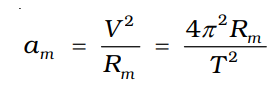
Kepler’s laws describe how planets move around the Sun. Newton showed that the gravitational force between the Sun and planets provides the necessary centripetal force required for circular and elliptical orbits. The decrease in gravitational influence with distance explains why objects orbit instead of falling directly into one another. The centripetal acceleration can be given as:

Universal Law of Gravitation

Newton’s Universal Law of Gravitation states that every particle of mass m1 in the universe attracts every other particle  of mass m2 separated by a distance r with a force that is:

  • Directly proportional to the product of their masses.
  • Inversely proportional to the square of the distance between their centres.

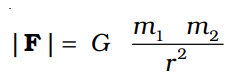
Mathematically,

This force acts along the line joining the two masses and is always attractive. The Universal Law of Gravitation helps explain natural phenomena such as planetary orbits, the tides, the motion of satellites, and the formation of galaxies.

Vector Form Of Gravitational Force

The Gravitational Force of point mass m2 due to another point mass m1 can be expressed as a vector form as:
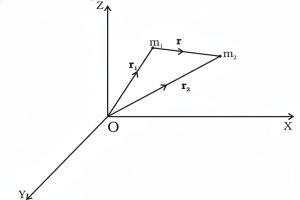
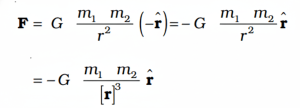
Where r  is a position vector from  m1 to m2  given as r = r2 – r1

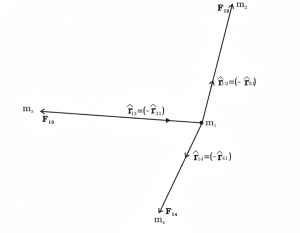
Net Gravitational Force for Multiple Point Masses

The Gravitational Force on point mass m1 due to multiple point masses m2 ,m3, mcan be expressed as a vector sum of all the forces acting on m1 and can be mathematically written as:

Gravitational Constant (G)

The constant of proportionality in Newton’s equation, represented by ( G ), is known as the universal gravitational constant. Henry Cavendish first measured its value using a torsion balance experiment. The magnitude of ( G ) determines the strength of the gravitational force between two masses.

Gravitational Field and Field Lines

A gravitational field is the region around a mass where it exerts a gravitational force on another mass. The gravitational field strength (( g )) at a point is the force experienced by a unit mass placed at that point. Gravitational field lines point toward the mass producing the field, showing that gravity is always attractive.

Vocabulary

This is the list of vocabulary terms used throughout the lesson.

  • Universal Law of Gravitation: Newton’s law stating that the gravitational force is proportional to the product of masses and inversely proportional to the square of the distance between them.
  • Gravitational Constant (G): A universal constant that determines the strength of the gravitational force.
  • Mass: The quantity of matter in a body that determines the strength of gravitational attraction.
  • Distance (r): The separation between the centres of two interacting masses.
  • Centripetal Force: The inward force required for an object to move in a circular path.
  • Gravitational Field: The region around a mass where it exerts gravitational influence.
  • Weight: The force exerted on a mass due to gravity, equal to ( mg ).
  • Torsion Balance: A sensitive instrument used by Cavendish to measure the gravitational constant.
  • Inverse-Square Law: A physical law stating that a quantity varies inversely with the square of the distance.
  • Orbit: A curved path followed by a celestial body under gravitational influence.
  • Satellite: An object that orbits a planet due to gravitational attraction.
  • Kepler’s Laws: Three laws describing planetary motion around the Sun.
  • Centripetal Acceleration: The acceleration directed toward the center of a circular path.
  • Attractive Force: A force that pulls two objects toward each other.
  • Field Lines: Imaginary lines representing the direction and strength of a field.

The Universal Law of Gravitation

Category

Introduction

Welcome to the Gravitation Virtual Reality (VR) Lab!
In this exciting simulation, you will explore one of the most powerful forces in the universe — gravity.

Gravity is the invisible force that pulls objects toward each other. It is the reason why a ball falls back to the ground when you throw it upward and why the Earth moves around the Sun in a perfect orbit.

In this virtual lab, you will get to see gravity in action, experiment with how mass and distance affect gravitational force, and truly understand how this universal force shapes our world and the universe. Through guided scenes, students will deepen their understanding of the scalar and vector forms of gravitational force and learn how to compute net gravitational force due to multiple bodies.

Key Features

  • Visualisation of real world examples of gravitational force using 3-D models. 
  • Real time force calculator with interactive simulation.
  • Multiple-Body Force Calculation: Understand how net gravitational force is determined when multiple masses act on a single point mass.
  • MCQs are integrated at the end of each module for engagement.

Step-by-Step Procedure for VR Experience

Step 1: Revolution of Earth around Sun

  • Watch the Earth revolve around the Sun in its orbit.
  • Learn that this circular motion is caused by the Sun’s gravitational attraction acting on Earth.

Step 2: Scalar Form of Gravitational Law

  • Adjust the masses and distance between two objects using sliders.
  • Observe how increasing mass increases the force, and increasing distance decreases it — shown in real time.

Step 3: Vector Form of Gravitational Law

  • View two point masses connected by a directional force arrow.
  • Understand how gravitational force acts along the line joining the masses.

Step 4: Net Gravitational Force from Multiple Point Masses

  • Learn how to calculate the net gravitational force on a single mass when multiple masses exert force on it.
  • Understand how forces are resolved and added vectorially.
  • Review sample diagrams showing force components.

Step 5: Simulation – Multiple-Body Gravitational System

  • Interact with three or more point masses placed at different positions.
  • Observe individual gravitational forces acting on the selected mass.
  • View the net force vector formed from the vector addition of all individual forces.
  • Manipulate positions and masses to see how the net force changes dynamically.

Step 6: Evaluation

  • After interaction, students proceed to the quiz:

    • 2  MCQs
This site is registered on wpml.org as a development site. Switch to a production site key to remove this banner.